Most people believe they are listening. Often, they are waiting for their turn to speak. While another person talks, the mind may already be preparing a reply, searching for mistakes, recalling an earlier argument, or deciding whether to agree. The ears remain open, but attention has moved away from understanding. It is preparing to defend.
PeaceDNA offers a different practice: Kanji Listening. Kanji Listening is the intentional discipline of listening to understand another person’s Conflict Position before explaining, correcting, judging, persuading, defending, or responding.
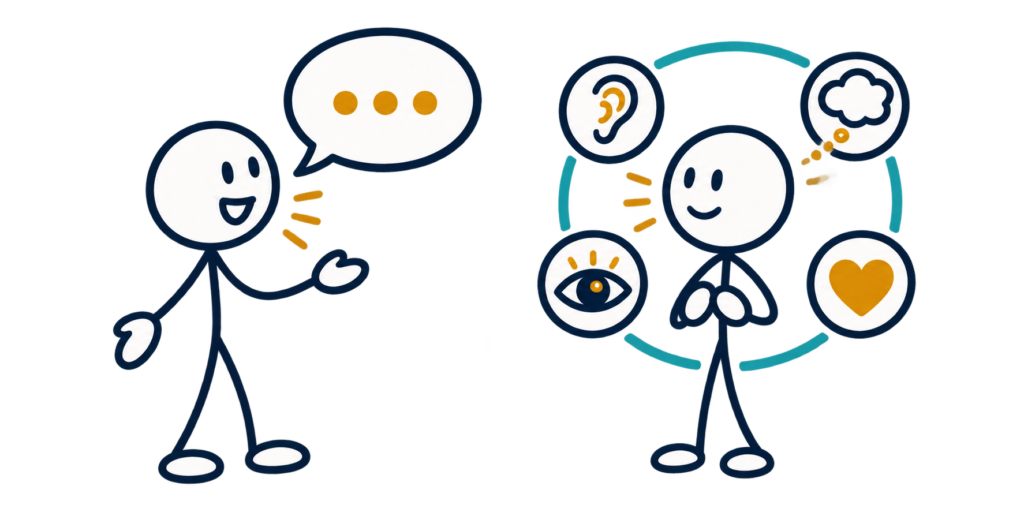
Learning to Kanji Listen will make you a better listener for your friends and family, even outside of conflict situations.
It begins with one question:
“Can I understand this person’s Conflict Position before deciding what I think about it?”
That question can change the direction of a conflict.
Listening for a Conflict Position
A Conflict Position is a person’s account of the Problem. It has three basic parts:
- Facts: What happened?
- Feelings: How did the person feel?
- Beliefs: What does the person believe the experience means?
Kanji Listening helps us receive these parts.
The ears hear the words and voice. The eyes observe body language. The mind organizes what is heard and seen. Attention governs them all. Without attention, the ears hear only fragments, the eyes miss important changes, and the mind fills the gaps with assumptions. With attention, the listener has a better chance of understanding the speaker’s Conflict Position as the speaker intends it.
Understanding does not require agreement. It requires listening before answering.
What Does Kanji Mean?
Kanji refers to the meaning-bearing characters Japan originally adopted from Chinese writing.
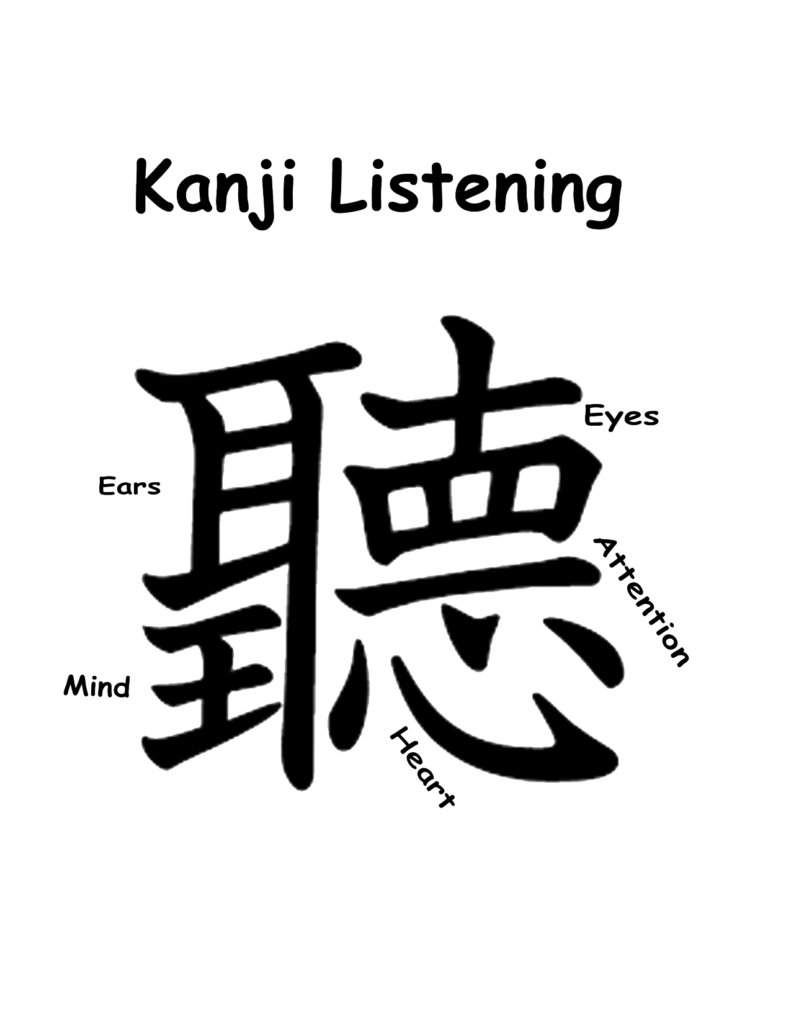
PeaceDNA uses the name Kanji Listening because a popular interpretation of a character associated with attentive listening provides a memorable teaching image. The modern Japanese character means to listen carefully or attentively as shown using five symbols:
- Ear
- King (Attention)
- Mind
- Eye
- Heart
This is a teaching metaphor. It is not presented as the character’s literal origin, an ancient Japanese listening method, or a scientifically proven model. The symbols simply give us an easier way to remember what intentional listening involves.
The Five (5) Listening Symbols
Ear — Hear the Message
The ear represents hearing what the speaker actually says along with tone, tempo, and volume. During conflict, strong feelings can narrow our attention. We may hear only the accusation, insult, or detail we think is wrong and/or offensive. The rest of the Conflict Position may be lost. This is why Kanji Listening pays attention to:
- The words spoken
- The details repeated
- The questions asked
- The tone, pace, and pauses
- The Facts, Feelings, and Beliefs being expressed
The speaker’s words provide the main path into their Conflict Position. Listen to those words instead of replacing them with what you assume the speaker means. This is to Kanji Listen. Stay present in the moment.
King (Attention) — Treat the Speaker as Important
The king represents giving the speaker respectful attention. It does not make the speaker superior. It does not require obedience or mean that everything said must be accepted as true. It is a reminder:
“While you express your Conflict Position, I will treat your experience as worthy of my attention.” Nothing more.
Each person should receive this same respect. When it is your turn to speak, your Position should receive the same care. Treat it so. Treat it with value.
Mind — Be Fully Present
In the popular teaching image, a cross-shaped element is interpreted as using your mind to organize all the incoming information (perceptions) and stay present in the moment. Being present may mean:
- Putting down the phone
- Stopping the rehearsal of a defense
- Allowing the speaker time to finish and be present
- Noticing when your attention wanders
- Requesting a pause when you can no longer listen well
Complete attention does not mean endless attention. A listener may need a break, a time limit, or help from outside (a mediator). Rephrasing can help slow down and settle various aspects of the speaker’s story.
Eye — Observe Without Assuming
The eyes observe what accompanies the words…Body Language. They may notice changes in facial expression, posture, breathing, movement, voice, or physical distance. These observations can provide useful clues about the speaker’s experience. However, body language does not reveal a person’s thoughts with certainty. They can, and often do, sense another person’s intentions. For example:
- Looking away does not prove dishonesty.
- Crossed arms do not prove hostility.
- A trembling voice does not prove fear.
- Silence does not prove agreement.
A visible change can be treated as a Fact:
“You became quiet.” or
“You started yelling & getting closer.”
What that change means remains a Belief until the person explains it and makes it a fact. It is a fact that they said it, not that the claim is true. Instead of deciding what the body language proves, ask:
“I noticed you became quiet when we discussed the meeting. Would you like to explain what was happening for you?”
The eyes observe. The attentive mind avoids pretending to read another person’s mind bug instead Kanji Listens.
Heart — Remember the Person
The heart represents empathy, care, and sincere curiosity. Listening with the heart means trying to understand why the Problem matters to the speaker:
- What did the person experience?
- What were they afraid of losing?
- What did they hope would happen?
- What Feeling may be beneath the argument?
- What expectations did they have?
Listening with the heart does not require agreement, approval, forgiveness, trust, reconciliation, or acceptance of blame. It also does not require abandoning a boundary or excusing harmful behavior. It’s more in the realm of listening with humanity, with humility.
Empathy is created from an effort to understand someone’s experience as they describe it. Building empathy through understanding is key to showing compassion in PeaceDNA; Step 3 – Remedy. Compassion may grow from understanding, but it cannot be demanded. It can only be gifted, growing more so with the feeling of empathy.
Attention Brings the Parts Together
The five symbols lead back to one central practice: pay attention to the person’s Conflict Position.
- The ears hear the message.
- The eyes observe body language.
- The mind considers the Facts, Feelings, and Beliefs.
- The heart keeps the person’s humanity in view.
- Attention directs the whole process.
This can be remembered in one sentence:
Listen with your ears, observe with your eyes, organize with your mind, care with your heart, and govern them all with attention.
That is Kanji Listening within PeaceDNA.
Understanding Is Not Agreement
When people feel unheard, they often repeat themselves. They may repeat the same event, accusation, or demand because they are still looking for evidence that someone understands. Kanji Listening can provide that evidence:
“Your experience matters enough for me to understand it before I judge it.”
Understanding and agreement are different. A listener can understand what someone reported without accepting every detail as proven. A listener can recognize another person’s Feelings without sharing them. A listener can understand a Belief without accepting it as true. This distinction makes respectful dialogue possible even when serious disagreement remains.
An Example: Hearing the Position
Consider this statement:
“You deliberately embarrassed me in front of everyone.”
Kanji Listening may identify:
- Possible Fact: Something was said or done in front of other people.
- Feeling: The speaker felt embarrassed.
- Belief: The action was deliberate.
The listener does not need to accept or reject the accusation immediately. Guiding Questions can help clarify the Position:
“What happened that made you believe I intended to embarrass you?”
“What part of the experience felt most embarrassing?”
These questions seek understanding. They should not become a cross-examination. Facts, Feelings, and Beliefs may appear in any order. The listener does not need to force the speaker’s natural story into three separate boxes.
Listening Before Correcting
Sometimes a listener hears something they strongly believe is wrong. The immediate impulse may be:
“That isn’t what happened.”
The correction may be important. Each person has the right to express a different Conflict Position. Kanji Listening asks whether the correction must happen immediately or whether the speaker can finish first. Waiting is not an admission of guilt or agreement. It means:
“I will try to understand your account before presenting mine.”
Once the first Position has been reasonably understood, the listener may explain how their own Facts, Feelings, or Beliefs differ. Both Conflict Positions deserve room to exist.
Checking Your Understanding
Kanji Listening is not passive silence. The listener may ask questions, seek clarification, or reflect back what was heard. A Rephrase for Yes can check understanding:
“Are you saying you felt excluded because you believed the decision had already been made without you?”
The speaker may say yes or correct the listener. That “yes” confirms only that the speaker’s intended meaning was accurately restated. It does not prove the claim, assign blame, compel forgiveness, or create agreement about a Remedy.
If the speaker says no, listen again. The purpose is not to collect a quick “yes.” The purpose is to understand accurately.
Why Positions Come Before Remedy
People often enter conflict believing they need agreement. What they may need first is evidence that they have been understood. When people feel understood, defensiveness may soften. The conversation can begin moving away from proving who is right and toward addressing the shared Problem.
This is why PeaceDNA places Conflict Positions before Remedy. A person may be less willing to explore a solution with someone they believe has ignored or misunderstood them. Understanding does not guarantee cooperation, empathy, agreement, or resolution. It gives peaceful dialogue a stronger starting point.
Listening Has Limits
Kanji Listening should never be used to compel someone to remain in an unsafe or abusive conversation. No one must continue listening while another person:
- Threatens violence
- Uses repeated abuse or humiliation
- Demands obedience
- Attempts to intimidate or control
- Pressures someone to withdraw a complaint
- Prevents access to needed help
- Makes direct participation unsafe
A boundary may be the correct response:
“Are you willing to continue without threatening me?” or
“Would you like to pause and continue with a mediator present?” or
“Can we communicate through a third party instead?”
If peaceful Conditions do not exist, pausing, leaving, or seeking help may be more important than continuing the conversation. No one must listen indefinitely to prove they are peaceful.
A Simple Kanji Listening Check
During a reasonably safe conversation, pause before responding and ask:
- Attention: Am I trying to understand, or am I preparing my defense?
- Ear: What did the person actually say? Was there a tone?
- Eye: What did I observe without assuming what it means?
- Mind: What Facts, Feelings, and Beliefs did I hear?
- Heart: Why does this appear important to the person?
Then check your understanding:
“Are you saying ______?”
If the speaker corrects you, listen again.
Where Peaceful Dialogue Begins
PeaceDNA is built on a working premise:
People may become more willing to explore Remedies after they believe their Conflict Position has been understood.
This is a PeaceDNA principle—not a promise or a scientifically proven rule. Listening cannot resolve every conflict or overcome every danger, power imbalance, false accusation, or refusal to cooperate. What it can do is improve the quality of a reasonably safe conversation.
Kanji Listening changes listening from ‘waiting’ into ‘intentional discovery’. The immediate purpose is not to win the argument or prepare the perfect answer. It is to understand another person’s Conflict Position well enough that both people may begin addressing the same Problem. That is where peaceful dialogue may begin.
Revised Red-Team Review
1. Teacher and General Reader
Analysis: The chapter now follows one central idea: attention helps the ears, eyes, mind, and heart understand a Conflict Position.
Concern tested: The earlier version asked readers to remember five symbols, three Position Parts, Guiding Questions, body language, and Rephrase for Yes at the same time.
Revision: Repeated explanations were removed, the symbols were shortened into listening reminders, and the practice exercise was reduced to five direct questions. The example connects the ideas without making the framework feel like a rigid checklist.
2. Conflict-Resolution Practitioner
Analysis: Kanji Listening remains clearly connected to Facts, Feelings, Beliefs, Guiding Questions, and Rephrase for Yes.
Risk tested: Breaking a story into parts could make listening mechanical.
Response: The chapter states that Facts, Feelings, and Beliefs may appear in any order and should not be forced into separate boxes. The speaker’s natural story continues to guide the conversation.
3. Trauma-Informed and Ethical Reviewer
Analysis: The chapter separates respectful listening from forced attention or exposure to harm.
Risk tested: A harmful person might demand listening or empathy as a way to prolong an abusive exchange.
Response: The chapter protects the right to set boundaries, pause, leave, use a third party, and seek help. Understanding does not require trust, forgiveness, agreement, or continued participation.
4. Skeptic and Cultural-Accuracy Reviewer
Analysis: The kanji image remains memorable without being presented as historical proof.
Risk tested: Readers might mistake the five-symbol interpretation for the authentic origin of 聽.
Response: The chapter identifies it as a PeaceDNA teaching metaphor rather than an ancient Japanese method, literal translation, or scientifically validated listening model.
Comment