We spend years learning how to read, write, work, drive, and use technology. Yet most of us receive little practical education about something we face throughout life: person-to-person conflict (P2P Conflict).
We may be told to “stay calm,” “talk it out,” or “work it out.” But what should we address first? How can we explain our experience clearly? How do we listen without immediately arguing? And how might two people move toward a peaceful, workable outcome even when they both would choose it?
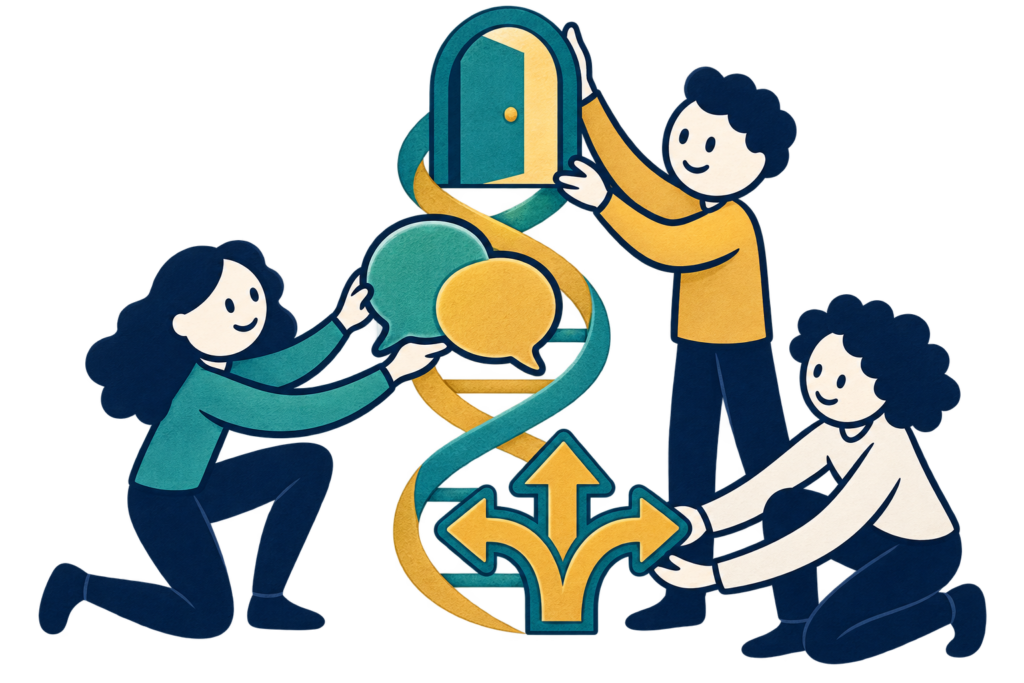
PeaceDNA is an AI-assisted peace-education project that organizes practical ideas for navigating everyday person-to-person (P2P) conflict.
PeaceDNA offers a simple map (a recipe) consisting of six Guiding Questions (GQ) that guide the line of questioning to uncover hidden elements and expose ‘blind spots’ in a speaker’s story as they work through the 3 steps of PeaceDNA. Because it’s an archetype, it works for both street mediation & self-use.
PeaceDNA is an AI-assisted peace-education project that organizes practical ideas for navigating everyday person-to-person (P2P) conflict. It is intended for conflicts involving family members, friends, neighbors, coworkers, classmates, and others who are willing and reasonably able to communicate peacefully.
PeaceDNA is an educational framework, not a scientifically proven formula. It is an archetype for P2P conflict resolution. It cannot guarantee honesty, understanding, empathy, agreement, or resolution. Instead, it provides a simple yet broad route that may help people slow down, organize the conversation, and reduce avoidable misunderstandings.
The PeaceDNA Map follows three Steps: Conditions, Conflict Positions, and Remedy. The six Guiding Questions help mark the route and move forward with intelligence (knowledge).
PeaceDNA Guiding Questions (GQ)
- GQ #1 “Are you ready and willing to solve this conflict peacefully?” (Conditions)
- GQ #2 “What happened?” (Facts)
- GQ #3 “How did/do you feel?” (Feelings)
- GQ #4 “Why do you feel that way about what happened?” (Beliefs)
- GQ #5 “What do you want now?”(Remedy)
- GQ #6 “What will you do now?” (Remedy)
Step 1 – Conditions
Before discussing the problem, both people consider whether peaceful communication is reasonably possible:
GQ1. Are you ready and willing, and reasonably able to address this conflict peacefully?
Conditions may include safety, timing, privacy, emotional intensity, tone, body language, fatigue, intoxication, fear, and each person’s freedom to speak, disagree, pause, or leave. Conditions do not need to be perfect, but there must be enough willingness and self-control to continue without violence, coercion, or persistent verbal attack (FOULs).
PeaceDNA is not intended for immediate danger, abuse, or coercive control. In unsafe situations, leaving, seeking help, or contacting an appropriate authority may be necessary. Willingness can also be withdrawn at any time.
Step 2 – Conflict Positions
When peaceful Conditions exist, each person can explore their Conflict Position—the place from which they currently experience the conflict. PeaceDNA separates that position into three connected parts:
- Facts: What happened that could be directly observed or reasonably verified?
- Feelings: What emotions did the person experience? What was their experience?
- Beliefs: What meaning did the person give the experience? What expectations did they hold?
Separating these parts does not prove who is right or reveal the complete truth. Memory can be incomplete, feelings can be difficult to name, and beliefs can be mistaken. However, the separation can help people notice assumptions, identify missing information, and communicate more clearly.
The three conflict position/interest questions can be asked in any order and revisited as understanding develops:
GQ 2. What happened? (Facts)
GQ 3. What did you feel? (Feelings)
GQ 4. What did you believe it meant? (Beliefs)
Step 3 – Remedy
After both Conflict Positions have been explored, the conversation can turn toward what happens next:
GQ 5. What do you want now to help resolve this conflict peacefully?
GQ 6. What will you offer to help resolve this conflict peacefully?
A workable Remedy should be peaceful, practical, reasonably clear, and freely accepted. It might include an apology, repaired harm, changed behavior, a boundary, or a future plan. Resolution does not always mean agreement. Sometimes the best available outcome is acceptance, respectful disagreement, outside assistance, or separation. Sometimes, agreeing to respectfully disagree can be a good option.
Three supporting skills can help people ‘travel’ the PeaceDNA:
FOUL Buster uses respectful questions to address non-dangerous verbal FOULs without re-FOULing. It’s an alternative way to reply to verbal FOULs without making things worse.
Kanji Listening encourages listening to understand before evaluating, correcting, defending, or persuading. Also, listens for Facts, Feelings, Beliefs, and FOULs.
Rephrase for Yes restates something already said as a short respectful question that the speaker can confirm, correct, or reject. Its limited purpose is to check understanding and promote, not manufacture, agreement.
PeaceDNA does not promise perfect results or an end to conflict. It offers a developing framework whose ideas can be named, practiced, questioned, tested, and improved. If it helps you approach even one difficult conversation more peacefully, please pay that knowledge forward.
Comment