Body Language, Intuition, Intention, and Trust
During conflict, words tell only part of the story. Someone may say, “I’m fine,” through clenched teeth. Another person may say, “I agree,” while moving away. A person may remain silent while their breathing, posture, or voice reveals that something has changed.
These non-word signals are called body language. Body language can alert us to information that words do not express. However, it must be interpreted carefully, very carefully.
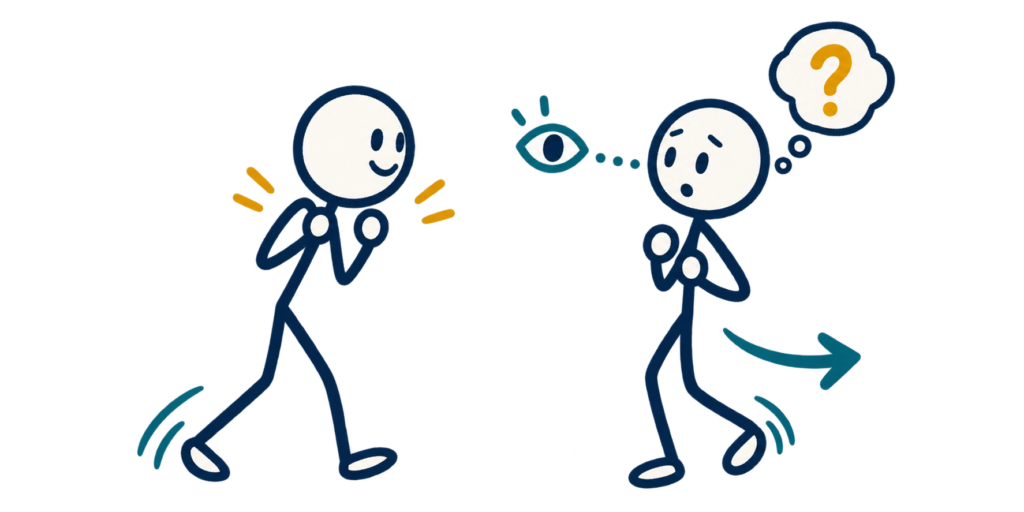
Body Language is the domain of intention and intuition. Intuition is the receiving of what intention is sending.
PeaceDNA makes an important distinction:
A body-language signal must be observable (or verbal). Its meaning is an interpretation only, even if inevitable and emotionally hooked together with a particular response (habit). The meaning is not factual, though it is often overlooked. Action is connected to intention but is accountable to community law.
A louder voice may be a Fact. Saying the speaker is angry, dishonest, or preparing to attack is a Belief about that Fact. It may be correct, but body language alone does not prove it. Body language gives us information to notice—not permission to read another person’s mind.
What Is Body Language? Body language includes non-word changes that another person can see or hear, such as:
- A hand movement or gesture.
- A change in facial expression.
- A flush or loss of color in the skin.
- Faster, slower, or interrupted breathing.
- A shift in posture, head position, or body weight.
- Moving closer or farther away.
- Increased stillness, pacing, or swaying.
- Changes in vocal tone, volume, pitch, tempo, or rhythm.
- A pause before answering.
- A change in where a person is looking.
These signals can become Facts within a PeaceDNA POV Position when they are described without exaggeration. For example:
“Your voice became louder, and you stepped closer.”
That describes what was seen and heard. Compare it with:
“You became forceful and tried to intimidate me.”
The second statement assigns both meaning and intention. It may reflect the observer’s honest experience, but it is still an interpretation requiring context. Clear DNA Language separates the observable signal from the story we create about it.
Observe With Confidence—Interpret With Humility
The same body-language signal can have several meanings. Crossed arms might suggest defensiveness. They might also mean the person is cold, tired, comfortable, in pain, or simply standing in a familiar position. Looking away might suggest discomfort. It could also reflect concentration, cultural expectations, anxiety, trauma, respect, disability, or sensory overload.
A pause could mean hesitation, fear, careful thinking, confusion, or a need for more time. Even a smile does not always mean happiness. People sometimes smile when nervous, embarrassed, frightened, or trying to lower tension. This leads to a useful PeaceDNA principle:
Observe with confidence. Interpret with humility. You may know that someone stepped backward. You should be less certain about why.
Instead of declaring:
“You stepped back because you’re afraid of me.”
Try a Guiding Question (Why did it matter?):
“I noticed you stepped back. Would you like more space?”
The first statement claims knowledge of another person’s inner experience. The second combines an observable Fact with a respectful opportunity to explain or set a boundary.
Intention: The Message Going Out
In PeaceDNA, intention means the aim or direction behind what a person says or does.
A person may intend to:
- Persuade.
- Comfort.
- Warn.
- Avoid.
- Impress.
- Challenge.
- Cooperate.
- Deceive.
- Protect.
- Threaten.
- Be understood.
Intention can influence words, tone, movement, distance, timing, breathing, and facial expression. Someone trying to persuade another person might lean forward, speak faster, or use animated hand movements. Someone trying to avoid a conversation might become quiet, turn away, or create more distance.
However, intention is not always visible. People may deliberately control their outward behavior. They may also communicate signals without realizing it. One behavior can result from several different intentions, and people do not always understand their own motives.
For that reason, PeaceDNA generally treats another person’s intention as a Belief unless the person explains it or reliable evidence establishes it. Body language may offer clues about intention. It does not prove intention.
Intuition: The Message Being Received
Intuition is the early internal impression that something feels safe, unsafe, trustworthy, uncertain, inviting, or concerning. It may appear before a person can explain why:
“Something changed.”
“I need more distance.”
“This feels comfortable.”
“I’m not ready to trust this.”
“I should pay closer attention.”
This is often called a gut feeling. The mind and nervous system constantly process posture, tone, movement, distance, facial expression, previous experiences, and the surrounding environment. Some of this processing may occur before conscious reasoning catches up.
PeaceDNA uses intuition as a practical term for this early signal. It does not claim that intuition is supernatural, perfect, or untouched by experience and emotion. Intuition can be influenced by:
- Previous experiences.
- Trauma.
- Habit.
- Fear or anxiety.
- Cultural expectations.
- Stereotypes and bias.
- Stress, exhaustion, illness, or medication.
- Familiarity and unfamiliarity.
- The immediate environment.
Therefore:
Intuition deserves attention, but not automatic certainty. An intuitive warning can justify pausing, creating distance, or leaving. It does not necessarily justify publicly accusing another person of an intention that has not been established.
Speaking and Listening Without Words
Body language can be understood as a two-way exchange:
- Intention concerns the message a person may be sending.
- Intuition concerns the impression another person receives.
One body communicates. Another body and mind respond. That response then becomes a new signal for the first person. For example:
- One person speaks sharply.
- The listener senses possible danger and steps backward.
- The speaker interprets that movement as rejection.
- The speaker raises their voice.
- The listener becomes more guarded.
Neither person may recognize the cycle while it is happening. Awareness creates an opportunity to interrupt it:
“I noticed that we both became louder. Would it help if we paused?”
This does not decide who is right. It identifies an observable change and invites both people to reconsider the Conditions needed for a peaceful conversation.
When Words and Body Language Do Not Match
Mind language and body language communicate differently. Mind language uses words, ideas, images, explanations, and logic. Body language uses movement, tension, distance, breathing, timing, tone, and expression. Sometimes they appear to match:
“I’m excited,” spoken energetically with animated movement.
Sometimes they appear not to match:
“I’m comfortable,” spoken while repeatedly moving away.
A mismatch deserves attention, but it does not reveal which message is “the truth.” The person may be hiding something. They might also be trying to remain calm, struggling to name a Feeling, reacting to something unrelated, or expressing themselves in a way the observer does not understand.
Avoid saying:
“Your body proves that you’re lying.”
A PeaceDNA response might be:
“You said you’re comfortable, but I noticed you moved farther away. Would more space help?”
This respects both the spoken message and the observable behavior without pretending that either tells the entire story.
Intuition as an Interpreter
Mind language and body language can be compared to two people speaking different languages. Both may be communicating about the same experience, but an accurate translation is not automatic. The mind sees a signal and asks:
“Why did they look away?”
“Why did their voice change?”
“Why did they move closer?”
When information is missing, the mind fills the gap. Sometimes its explanation is accurate. Sometimes it grows from memory, fear, expectation, or bias. Intuition may alert us that a change matters. Thought attempts to explain it. Emotion adds force. Judgment forms a conclusion. A simplified PeaceDNA teaching model is:
Signal → Intuitive impression → Thoughts and Feelings → Judgment → Choice
This is not presented as a complete scientific account of how the brain processes social information. In real life, these processes overlap and may occur almost simultaneously. The model is useful because it gives us places to pause and ask:
- What did I actually observe?
- What did I immediately sense?
- What Feelings followed?
- What explanation did my mind create?
- What judgment am I making?
- What other explanations might fit?
- What safe response is available?
That brief pause can help separate a useful warning from an unsupported assumption.
Trust Is Not Certainty
PeaceDNA connects intuition with a person’s immediate sense of trust. Trust does not mean knowing that nothing bad will happen. It is the amount of openness a person is presently willing to risk. This explains why knowledge is power; it expands our range of what to trust.
You may trust someone enough to continue talking but not enough to meet privately. You may trust a process enough to participate when a mediator is present. You might trust someone’s goodwill while still checking the accuracy of their information. Trust can have levels. Depending on the Conditions, you might decide to:
- Continue the conversation.
- Slow it down.
- Ask a Guiding Question.
- Set a boundary.
- Request a witness or mediator.
- Change the location or communication method.
- Pause the discussion.
- Leave and seek help.
Trust should not be confused with blind faith. Trust does not require:
- Ignoring warning signs.
- Pretending risk does not exist.
- Giving up boundaries.
- Agreeing with another person.
- Sharing private information.
- Forgiving harm.
- Accepting an apology.
- Remaining in an unsafe conversation.
- Making yourself defenseless.
Trust can be a cautious opening rather than complete confidence. You can remain open to peaceful engagement while still protecting yourself.
Risk, Fear, and Trust
Risk and trust often affect one another. As perceived risk rises, a person’s willingness to trust may fall. Caution, fear, or protective action may increase. A person might fear:
- Being embarrassed or rejected.
- Being misunderstood.
- Losing time, money, status, or an opportunity.
- Being deceived or pressured.
- Being punished for speaking honestly.
- Being physically harmed.
Some fears concern what might happen next. Others come from harm happening now or from previous experiences. For that reason, fear should not be defined only as an imagined future or the simple absence of trust. Fear is a protective emotional response that may be triggered by a real threat, a remembered threat, uncertainty, or a mistaken interpretation.
Fear can be uncomfortable without being irrational. Trust can feel comfortable without being deserved. Neither one, by itself, proves what is safe. A more careful principle is:
Use intuition to notice. Use evidence and context to assess. Use boundaries to protect.
Intuition Is Not Judgment
An early impression and a finished judgment are not the same. Consider this possible sequence:
Intuitive impression: “Something feels different.”
Feeling: “I’m becoming uneasy.”
Thought: “That voice reminds me of someone who threatened me.”
Judgment: “This person is dangerous.”
The final judgment may be correct, partly correct, or incorrect. Recognizing the sequence helps us understand how the conclusion developed. This does not mean you should ignore a warning until every detail is proven. You do not need courtroom-level evidence before creating distance or leaving an uncomfortable situation.
It means that a private warning should not automatically become a public accusation. You can say:
“I’m not comfortable continuing this conversation here.”
You do not have to say:
“Your posture proves that you plan to hurt me.”
The first statement communicates a boundary. The second claims knowledge that body language alone cannot establish.
When Intuition Warns of Danger
If you observe a weapon, direct threat, blocked exit, stalking behavior, aggressive movement, escalating violence, or another immediate danger, safety takes priority over dialogue.
Do not remain in danger merely to determine whether your intuition is “pure” or whether you have interpreted every signal correctly. Depending on the situation, a safer response may include:
- Creating physical distance.
- Moving toward other people or a safer location.
- Leaving without further discussion.
- Contacting emergency services.
- Seeking help from security, a supervisor, an advocate, or a trusted person.
- Communicating through a third party.
- Documenting the conduct when it is safe and lawful.
An intuitive warning does not have to prove another person’s intention before you take reasonable protective action. PeaceDNA is a conflict-navigation framework. It is not a substitute for emergency help, professional threat assessment, medical care, legal advice, or protection from abuse.
Body Language Within a POV Position
Body language can add important information to a PeaceDNA POV Position, but it should be placed in the correct POV Part. Consider:
“You stood up, pointed at me, and raised your voice. I felt frightened because I believed you might hurt me.”
This separates the experience clearly:
- Facts: The person stood, pointed, and raised their voice.
- Feeling: The speaker felt frightened.
- Belief: The speaker believed physical harm might occur.
The speaker’s fear is real even if the listener denies intending harm. At the same time, the fear does not automatically prove the listener’s intention. A useful Guiding Question could be:
“Are you saying that when I stood and raised my voice, you felt frightened because you believed I might hurt you?”
If confirmed, this Rephrase for Yes establishes the speaker’s intended meaning. It does not require the listener to admit intending violence. The listener may later explain:
“I understand why that frightened you. I was angry, but I did not intend to hurt you.”
Now the conversation contains two Positions that can be examined without confusing observation, Feeling, Belief, and intention.
A Practical Body-Language Check
When a non-word signal catches your attention, try this process:
- Observe
What did I actually see or hear?
- Sense
What was my first internal response?
- Separate
Which parts are Facts, Feelings, Beliefs, memories, and judgments?
- Consider context
Could culture, disability, trauma, stress, pain, or the environment explain the signal differently?
- Ask when appropriate
Can a respectful Guiding Question clarify the meaning?
- Protect
Do I need distance, a pause, a boundary, another person’s help, or an immediate exit? Even a simple question may be enough: “I noticed your voice changed. What is happening for you right now?”
When danger is present, however, do not prioritize clarification over safety.
Creating the Conditions for Choice
Body language may show us that the Conditions of a conversation are changing before anyone says so aloud. A shift in distance, voice, breathing, or posture can signal that it is time to slow down, ask a question, establish a boundary, or stop. The central lesson is not that the body always tells the truth or that intuition is always right. Both claims go too far. The stronger lesson is this:
Body language provides observable signals. Intuition calls attention to those signals. Thought and emotion help interpret them. Judgment shapes the response. PeaceDNA helps us slow that process down enough to create a choice. Body language may offer clues about intention.
Intuition may alert us to trust or risk.
The mind creates meaning.
Emotion adds force.
Judgment guides action.
Knowledge expands our choices.
And choice—protected by safety, humility, and clear DNA Language—is where peaceful engagement may become possible.
Three-Perspective Red-Team Review
1. Conflict-Resolution Practitioner
Analysis: The section usefully connects body language with Conditions, POV Parts, Guiding Questions, and Rephrase for Yes.
Risk tested: Readers might focus so heavily on gestures and tone that they stop listening to the speaker’s words.
Response: The revision treats body language as one source of information, not a secret code. It encourages observable descriptions and respectful questions instead of confident interpretations.
2. Trauma-Informed Safety Reviewer
Analysis: Intuition can provide an important warning, especially when a person has noticed danger before consciously explaining it.
Risk tested: Encouraging readers to remain open and trusting could pressure someone to continue an unsafe encounter. Telling them to question intuition could also cause dangerous hesitation.
Response: The section gives safety priority over dialogue. A person may create distance, leave, set boundaries, or seek help without first proving another person’s intention.
3. Behavioral-Science and Bias Reviewer
Analysis: Claims that bodies always reveal true intentions, that intuition is uncontaminated by thought, or that fear simply equals missing trust are too absolute.
Risk tested: Readers could mistake personal interpretations, cultural expectations, trauma responses, disability-related behavior, or stereotypes for reliable detection of dishonesty or danger.
Response: The revision presents the PeaceDNA sequence as a teaching model rather than settled science. It separates observation from interpretation and treats intuition as valuable but fallible, context-dependent information.
Comment