Terms & Definitions
Before learning how PeaceDNA works, we first need to learn its DNA Conflict Resolution Language. Biological DNA carries instructions for the structure of living organisms. Language carries meaning. PeaceDNA joins these ideas as a teaching metaphor: its DNA Language names the essential parts of P2P conflict and shows how they fit together.
This is not a claim that PeaceDNA is connected to genetics or biological science. It is a practical way to organize conflict-resolution knowledge and see old things in a new way.
Clear definitions matter. During conflict, a belief may be presented as a fact, a feeling may be hidden inside an accusation, or people may argue over a Remedy before fully understanding the Problem. PeaceDNA’s Language can help us recognize where we are, what needs attention, and which question could come next.
Similar words can have very different meanings. Respect will follow leadership, even in conflict. Knowledge is a powerful equalizer.
To make these terms easier to understand, we will follow one ordinary conflict throughout this section.
A Continuing Example: The Changed Schedule
Maya and Jordan are coworkers. On Friday, Jordan changes the following week’s work schedule. Maya does not learn about the change until Sunday night. She becomes angry because the new schedule interferes with an important family commitment.
Maya says:
“You changed my schedule without telling me. You obviously don’t respect my time.”
Jordan answers:
“You always blame me when you don’t get your way.”
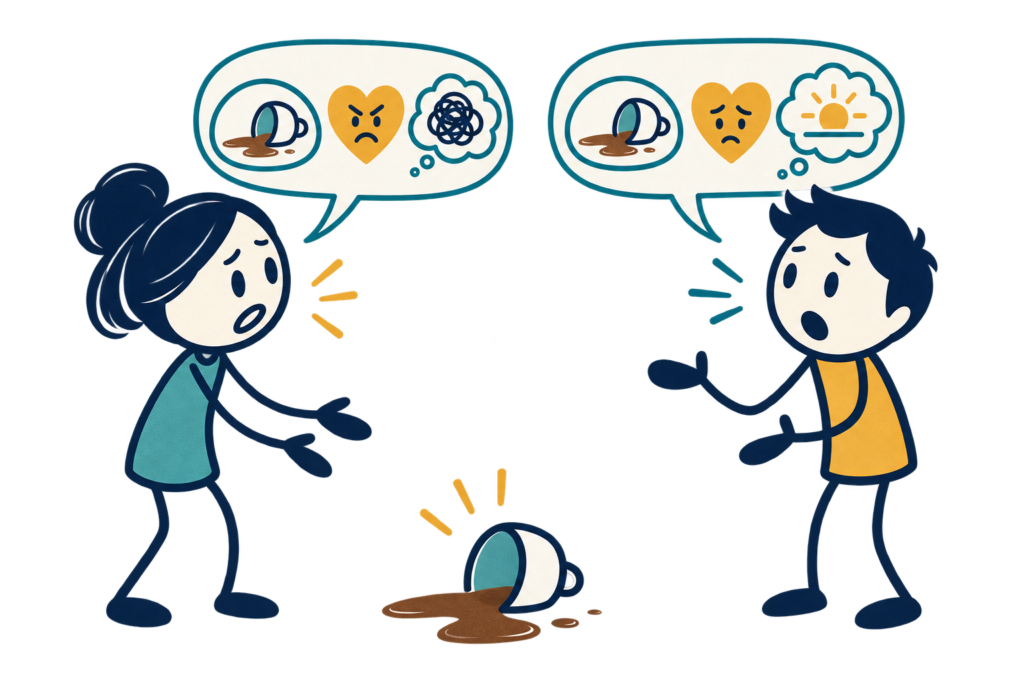
The exchange now contains Facts, Feelings, Beliefs, a P2P Conflict Problem, and possible FOULs. PeaceDNA’s Language helps separate these parts so they can be explored.
Person-to-Person Conflict
A person-to-person conflict, or P2P Conflict, develops when the Problems and Positions of two people intersect. Each person may remember different events, feel different emotions, assign different meanings, and want different outcomes. Their Positions may overlap, contradict each other, or appear impossible to reconcile.
Maya believes Jordan failed to respect her time. Jordan believes the schedule needed to change and that Maya is unfairly blaming him. Their Problems and Conflict Positions now intersect.
PeaceDNA treats conflict as a noun—something two people are experiencing—rather than a verb describing what they are doing to each other. This encourages Maya and Jordan to face the conflict as the shared problem instead of treating each other (person) as the problem.
P2P Conflict Problem
A P2P Conflict Problem forms when a person wants, needs, expects, or values something and believes another person is withholding, denying, threatening, or obstructing it. The desired outcome may be tangible, such as money, property, time, access, or completed work. It may also be intangible, such as respect, trust, safety, honesty, recognition, or fair treatment.
Maya values advance notice and enough control over her time to meet her family responsibilities. She believes Jordan’s schedule change interfered with both. Jordan may value flexibility and believe Maya is obstructing his ability to manage the workplace. Because each person may define the Problem differently, PeaceDNA does not assume that either description is the complete truth.
The PeaceDNA Map
The PeaceDNA Map organizes P2P Conflict resolution into three Steps:
- Conditions
- Conflict Positions
- Remedy
The Map does not guarantee honesty, empathy, agreement, or resolution. It offers a route that may help two willing people organize the conversation and reduce avoidable misunderstandings.
Step 1 – Conditions
Conditions are the circumstances that affect whether peaceful communication is reasonably possible. They include safety, willingness, timing, privacy, emotional intensity, tone, body language, fatigue, intoxication, fear, and each person’s freedom to speak, disagree, pause, or leave.
The first Guiding Question (GQ), intended to affirm that we are ready and ‘set the stage’ to begin PeaceDNA, asks:
GQ #1 – ‘Are we ready and willing to address this conflict peacefully?‘
Suppose Maya and Jordan begin arguing loudly in front of customers. That may be the wrong time and place to continue. They might agree to pause and meet privately after both have had time to settle.
When it is inappropriate to directly ask, as in when using for yourself, a cautious visual ‘Body Language’ assessment may be used to carefully advance into the PeaceDNA GQs.
PeaceDNA is not intended for immediate danger, abuse, or coercive control. It must never be used to pressure someone to remain in an unsafe interaction. A person may withdraw willingness at any time.
Step 2: Conflict Positions
A Conflict Position is the temporary mental and emotional place from which a person experiences and understands the conflict.
Earlier PeaceDNA writing used Point of View, or POV Position. “Conflict Position” is now the preferred term because it identifies a person’s present location within a specific conflict. It does not mean a battle stance, permanent identity, or final judgment.
PeaceDNA organizes a Conflict Position into three connected parts:
- Facts (GQ 2 – “What happened?”)
- Feelings (GQ 3 – “How did/does it feel?”)
- Beliefs (GQ – “Why does what happened make you feel that way?”)
Together, they provide a working snapshot of what happened, how it was experienced, and what the person believes it means. This is a conflict position. This three-part structure is a PeaceDNA premise—not a scientific claim that all human awareness fits perfectly into three categories.
GQ 2 – Facts: ‘What Happened?‘
Facts are events, words, actions, or physical details that were directly observed or can be reasonably verified. In the schedule conflict, possible Facts include:
- Jordan changed the posted schedule on Friday.
- Maya was not at work when it was changed.
- Maya saw the new schedule on Sunday night.
- The new hours interfered with Maya’s family plans.
A Fact is different from a claim about another person’s motives.
“Jordan changed the schedule” describes an observable action.
“Jordan changed it because he does not respect Maya” adds a Belief about Jordan’s intention.
The occurrence of a statement may also be factual even when its content is false. It may be a Fact that Maya said, “Everybody thinks Jordan is unfair.” That does not prove that everybody actually thinks it.
GQ 3 – Feelings: ‘How did/does it feel?‘ (or ‘What was experienced?‘)
Feelings are a person’s internal emotional experiences, such as anger, fear, sadness, embarrassment, disappointment, relief, or confusion.
Maya might say:
“I felt angry, worried, and unimportant when I saw the change.”
Jordan might say:
“I felt attacked and frustrated when you confronted me in front of everyone.”
Another person may observe a raised voice, tears, silence, shaking hands, or a change in posture. Those signals are observable, but their emotional meaning must still be interpreted.
Feelings are real experiences and perceptions, but they do not prove that a connected Belief is accurate. Maya’s feeling of being disrespected does not prove that Jordan intended disrespect. Jordan’s feeling of being attacked does not prove that Maya intended to attack him.
GQ 4 – Beliefs: ‘Why did it matter?’ (or ‘Why was it important?’)
Beliefs are the meanings, interpretations, assumptions, expectations, judgments, predictions, or conclusions connected to an experience. Opinions are treated as a kind of Belief so that Maya may believe:
- “Jordan does not respect my time.”
- “He expects me to accept whatever he decides.”
- “This will keep happening.”
Jordan may believe:
- “Maya blames me for every unwanted change.”
- “She does not understand my responsibilities.”
- “Nothing I say will satisfy her.”
A Belief may be accurate, inevidable, reasonable, mistaken, incomplete, or impossible to prove. Identifying something as a Belief does not dismiss it. It makes the meaning available for exploration.
A useful shortcut for identification is:
If it is not a Fact and not a Feeling, examine it as a possible Belief.
Step 3 – Remedy
A Remedy is a peaceful, practical response developed after both Conflict Positions have been explored (and potentially rephrased). The final two Guiding Questions ask:
GQ 5 – What do you want now to help resolve this conflict peacefully?
GQ 6 – What will you do now to help resolve this conflict peacefully?
Maya may want earlier notice of schedule changes. She may offer to keep her availability updated.
Jordan may want flexibility when workplace needs change. He may offer to contact affected employees before finalizing a change.
Their possible Peace Agreement might be:
“When possible, Jordan will give at least three days’ notice of schedule changes. Maya will keep her unavailable times updated and respond to change requests within one day.”
A Remedy may also involve an apology, repaired harm, a boundary, outside assistance, respectful disagreement, or separation. It should be peaceful, practical, reasonably clear, and freely accepted.
Only the victim knows what they truly want for remedy. Let it be expressed and acknowledged, without premature judgment.
Peace Agreement
A Peace Agreement is a freely accepted understanding about what happens next. It may identify actions, boundaries, responsibilities, timing, or ways to repair harm. An agreement is not sustainable merely because both people say yes.
Its strength depends on whether it is safe, voluntary, practical, understood, and followed over time.
Guiding Questions
A Guiding Question (GQ) directs attention toward an area that needs exploration. It is a navigational marker, not a rigid script. Because there are 6 specific GQs to use in PeaceDNA, no critical element is forgotten, assumed, left out, or disconnected, diminishing the speaker’s complete and whole ‘story’ (POV). Steps 1 to 3 flow naturally but require completion of the previous step.
PeaceDNA uses six GQs:
- Are we ready and willing to address this conflict peacefully?
- What happened?
- How did/do you feel?
- What did you believe it meant?
- What do you want now to help resolve this conflict peacefully?
- What will you do now to help resolve this conflict peacefully?
These questions can be adapted naturally. For example:
- “Maya, what did you see & hear?” (GQ 2 – Fact)
- “How did the change affect you?” (GQ 3 – Feeling)
- “What did the change mean to you?” (GQ 4 – Belief)
- “Jordan, what happened from your position?” (GQ 2 – Fact)
- “How did Maya’s response affect you?” (GQ 3 – Feeling)
- “What did you believe was happening?” (GQ 4- Belief)
- “What were you expecting?” (GQ 4 – Belief)
- “What did you/they say next”? (GQ 3 – Fact)
- “What about before that?” (GQ 3 – Fact)
You can ask the three Conflict Position questions in any order, back and forth, and revisit them as a natural ‘telling’ unfolds. GQs should invite exploration, not become an interrogation or hide an accusation.
FOUL
A FOUL is a verbal or physical action that attacks, threatens, means to intimidate, humiliates, degrades, or punishes a person instead of addressing the conflict problem.
Maya’s statement, “You obviously don’t respect my time,” may function as an accusation, a FOUL.
Jordan’s response, “You always blame me when you don’t get your way,” uses an absolute claim and attacks Maya’s behavior or character (re-FOUL).
Not every criticism, mistake, uncomfortable statement, or raised voice is automatically a FOUL. Context, wording, patterns, effects, and possible intent all matter. The FOUL label must not be used to silence criticism or avoid responsibility.
It is the intention behind an action that defines it as a FOUL, but because intentions are internal, the determination of a FOUL ultimately comes from your own (internal) intuition. Unwarranted fear or feelings of vulnerability can easily trigger the intuition as a danger signal. This is where knowledge and competency can help lessen the knee-jerk response to assertive stimuli.
Some lookalike FOULs are simply rude, thoughtless, and careless behavior that has no intent of hurt, harm, or intimidation. They’re just rude. This may be Maya’s sincere Belief, but Jordan’s internal attitude has not been directly observed or verified.
If FOULs take over, Conditions must be restored before the conversation continues.
FOUL Buster
FOUL Buster is a verbal self-defense skill for responding to many non-dangerous verbal FOULs with respectful questions instead of counterattacks.
Jordan might respond to Maya’s accusation by asking:
“Are you saying the schedule change caused you to believe I do not respect your time?”
This does not admit guilt or prove Maya’s Belief. It helps move the conversation away from personal attack and toward the experience beneath it.
FOUL Buster is not a complete conflict-resolution process and should never replace one or leaving the area or seeking help when danger is present. It addresses non-dangerous FOULs so that PeaceDNA efforts can move forward.
The PeaceDNA FOUL Buster asks 3 questions:
- “Stop, what’s the problem?” or “Why would you say that?”
- “Are you saying (rephrase)?” or “Do you mean (rephrase)?”
- “(FOUL name) is an option; is there another?” & “That’s an option; is there another?”
Faux Fact – Faux Fact FOUL – and Faux Fact Buster
These three terms are related but perform different jobs.
A Faux (Fake) Fact is a Belief, judgment, assumption, interpretation, or prediction presented or assumed to be as if it were an established Fact when it is not.
A Faux Fact FOUL is a claimed or assumed Faux Fact used to attack, accuse, humiliate, or intimidate someone.
Example:
“You obviously don’t respect anyone but yourself.”
This presents an unverified judgment as certain and uses it as a personal attack. An expression of ill will.
A Faux Fact Buster is a respectful question that moves the hostile claim from a supposed Fact into a Belief and Opinion, where it can be explored. For example:
“Are you saying the schedule change made you believe I do not respect your time?”
Or
“Are you saying that, in your opinion, I changed your schedule because I don’t care about you?”
The question does not declare Maya right or wrong. It separates the event—the schedule change—from Maya’s interpretation of what it meant. It was not a correct fact.
A disputed Fact is not automatically a Faux Fact. People may remember events differently, lack complete evidence, or make honest mistakes. These labels should clarify communication, not dismiss another person’s experience.
Disowned FOUL
A Disowned FOUL occurs when someone delivers a harmful message and then avoids responsibility for it. Examples include:
- “I was only kidding.”
- “You’re too sensitive.”
- “Can’t you take a joke?”
- “I’m just telling the truth.”
Suppose Jordan says, “Maya can never handle a simple change,” and then adds, “Relax—I was joking.” Calling it a joke does not automatically erase its effect or his responsibility. At the same time, context still matters, and misunderstanding remains possible.
Rephrase
A Rephrase restates another person’s meaning in their own words to both check understanding and get agreement. Maya might say:
“I had promised my mother I would take her to an appointment. When I saw the schedule, I panicked.”
Jordan might Rephrase:
“Do you mean that the late notice put you in a position where you might break an important promise to your mother?”
A useful Rephrase preserves the speaker’s meaning, adds no unsupported information, and allows for correction or expansion.
Rephrase for Yes
Rephrase for Yes, (R4Y), turns something already said into a short question the speaker can honestly confirm. Jordan might ask:
“Are you saying the late notice created a conflict with an important family responsibility?”
Maya may answer:
- “Yes.”
- “Partly.”
- “Not exactly.”
- “What I mean is…”
Every response can improve understanding, the goal of a R4Y. A sincere “yes” confirms one limited point: Jordan accurately understood what Maya communicated. It does not prove that Maya’s Beliefs are correct, create agreement about the entire conflict, or provide consent for a Remedy. But it is agreement.
Re4Y must not distort the message, add new information, or corner someone into agreement (not yet). It can, however, help confirm information such as how a person might be feeling. For example:
“Do you mean you felt threatened by what was said and also the way he said it?”
Kanji Listening
Kanji Listening is PeaceDNA’s name for listening to understand before evaluating, correcting, defending, advising, or persuading. It encourages directed attention through five dimensions: ears, eyes, heart, mind, and presence. This means listening to words, observing body language without pretending to read minds, noticing emotional meaning, following the speaker’s reasoning, and remaining present.
While listening to Maya, Jordan listens for her Facts, Feelings, and Beliefs. While listening to Jordan, Maya does the same. Understanding does not require agreement, approval, trust, forgiveness, or surrendering a boundary. Kanji Listening may support empathy, but of course it cannot guarantee it.
Quick-Reference DNA Glossary
| Term | Plain-language meaning |
| P2P Conflict Problem | A person believes someone is blocking or threatening something important. |
| P2P Conflict | The Problems and Conflict Positions of two people intersect. |
| Conditions | The circumstances that determine whether peaceful communication is reasonably possible. |
| Conflict Position | A person’s present experience of the conflict, organized into Facts, Feelings, and Beliefs. |
| Fact | Something directly observed or reasonably verified. |
| Feeling | An internally experienced emotion. |
| Belief | The meaning, judgment, assumption, or conclusion attached to an experience. |
| Guiding Question | A question that directs attention toward a part of the PeaceDNA Map. |
| FOUL | A person-focused ill intention that interferes with peaceful communication. Poison to peace. |
| FOUL Buster | A respectful set of 3 questions used to respectfully address many non-dangerous verbal FOULs. |
| Faux Fact | A fake fact. An opinion or belief wrongly presented, claimed, or assumed to be an established Fact. |
| Faux Fact FOUL | A hostile Faux Fact used as or to support a verbal assault. Remember, it’s the intention that defines a FOUL. |
| Fact Buster | A R4Y question add-in that separates the factual claim from the hostile Belief attached to it. (“Are you saying, in your opinion,(rephrase)?” |
| Rephrase | Restating someone’s meaning to check understanding. Not repeating the same words. USE DIFFERENT WORDS. |
| Rephrase for Yes | A question that invites and compels confirmation of one accurately understood message:”Are you saying? or Do you mean?” |
| Kanji Listening | Listening to understand before evaluating, defending, or persuading. A directed attention practice |
| Remedy | A peaceful, practical voluntary response to the conflict. |
| Peace Agreement | A freely accepted understanding about what happens next. |
PeaceDNA’s DNA Language cannot eliminate conflict or guarantee peace. It offers a shared vocabulary and understanding that may help people see the parts more clearly, ask useful questions, and search for a peaceful way forward.
Comment